

The 2026 Long-Term Cross-Border Innovation Project, developed within the framework of the Erasmus+ NomadTrail project, has been successfully completed. On 12 June 2026, students from the University of the Basque Country (EHU/UPV), Dortmund University of Applied Sciences and Arts (FH Dortmund), and KU Leuven presented their final results during an online closing session, marking the end of several months of international collaboration.
The project was carried out as part of Erasmus+ NomadTrail (Project Reference: 2023-1-DE01-KA220-HED-000153927). Student teams began their work on 23 February 2026 and collaborated until 12 June 2026, working across borders in virtual teams. Throughout the project, participants used digital collaboration tools to exchange ideas, coordinate tasks, and jointly develop their solutions. In addition, the students met in person during a mobility week in March, which provided an opportunity to strengthen teamwork and further develop their project concepts.
The theme of this year’s edition, “Energy and Energy Usage,” encouraged participants to explore current and future challenges related to energy consumption and sustainability. Topics such as the growing impact of artificial intelligence, the electrification of society, and uncertainties in energy supply served as the starting point for innovative discussions and project ideas.
Within this context, students were tasked with designing and developing a game application that would engage players in energy-related challenges and encourage them to think critically about possible solutions.
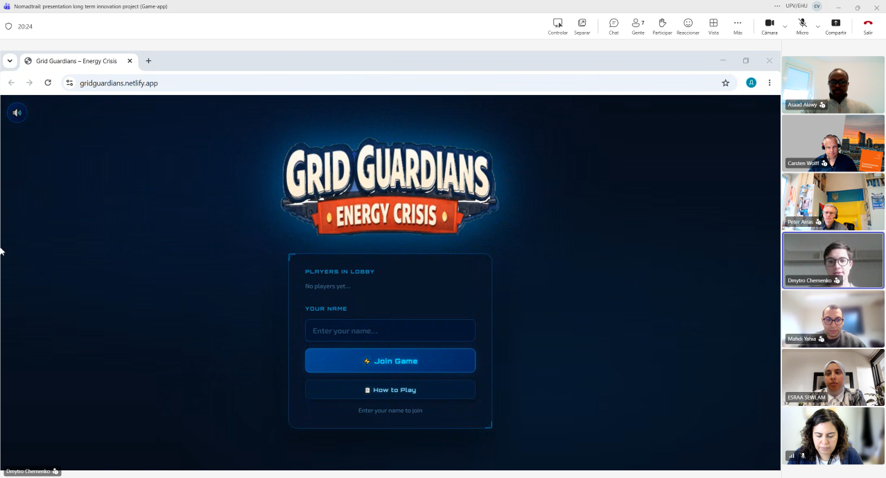
The international team developed Grid Guardians: Energy Crisis, a cooperative educational game focused on renewable energy, sustainability, and decision-making. The game challenges players to address different energy scenarios while balancing three interconnected dimensions: Economy, Environment, and Society. In doing so, players gain a deeper understanding of sustainability as a concept that extends beyond environmental protection and also encompasses social and economic considerations.
During the final presentation, the students introduced the concept behind the game, explained its mechanics, and demonstrated its educational value. One of the game’s defining features is its cooperative approach: rather than competing against one another, players work together, discuss alternative strategies, and reflect on the consequences of their decisions. This makes the game particularly suitable for educational settings, where collaboration, critical thinking, and discussion play a central role in the learning process.
The final project presentation was evaluated by an academic panel consisting of Carsten Wolff, Peter Arras, and Carolina Cruz-Villazón, who provided feedback on both the project outcomes and the team’s collaborative approach. The reviewers praised the students’ ability to address a complex societal challenge through an engaging and educational digital solution.
The successful completion of the 2026 Long-Term Cross-Border Innovation Project once again demonstrates the value of the NomadTrail framework in promoting international cooperation, digital learning, and applied innovation. At the same time, it highlights how students can develop intercultural, technical, and project management skills while working on real-world challenges with relevance for society and the future of sustainable development.
More information about the Erasmus+ NomadTrail project is available on the project website.