

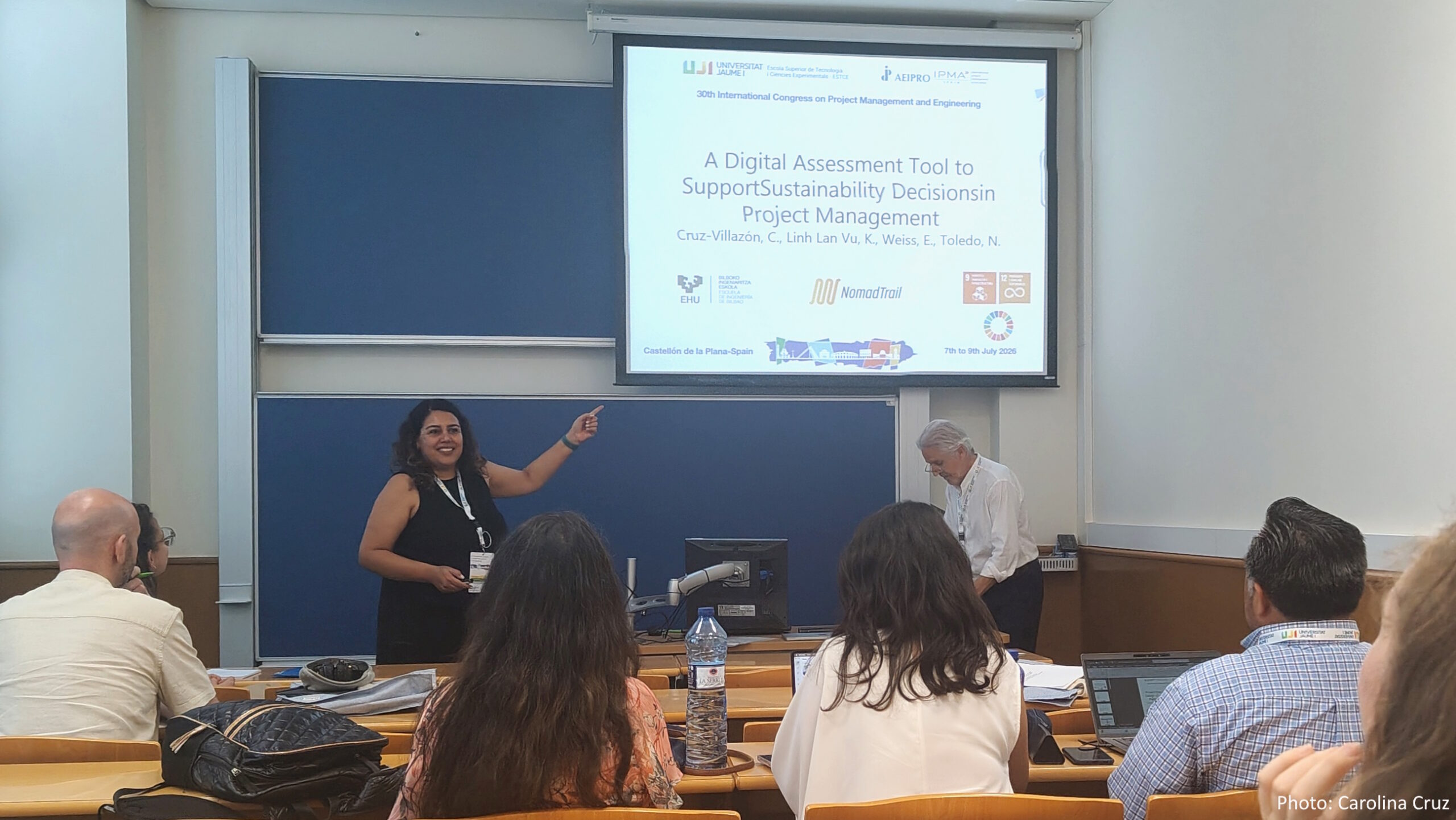
Bringing sustainability into real project decisions requires more than awareness. Project teams need practical tools that help them identify impacts, compare alternatives, and discuss trade-offs. This challenge was at the focus of the paper “A Digital Assessment Tool to Support Sustainability Decisions in Project Management”, presented at the 30th International Congress on Project Management and Engineering (CIDIP/ICPME 2026). The congress was held from 7 to 9 July 2026 at Universitat Jaume I in Castelló de la Plana, Spain. It was jointly organised by the university and the Spanish Association for Project Management and Engineering (AEIPRO), the Spanish member association of the International Project Management Association (IPMA).
The paper was presented by Dr. Carolina Cruz-Villazón, from the University of the Basque Country (EHU), a partner in the European Partnership for Project and Innovation Management (EuroPIM) consortium. The presentation focused on the digitalisation of the Digital Sustainability Canvas (DSC), a tool developed within the framework of the Erasmus+ NomadTrail project.
This digitalisation represents an important innovation, transforming the original canvas from a workshop-based reflection tool into an interactive platform that supports sustainability-oriented project decisions. The digital DSC helps teams identify and organise the environmental, social and economic impacts associated with a project. Users can classify impacts as direct, indirect, or hidden, connect them to sustainability categories and the United Nations Sustainable Development Goals, and assess their significance. The platform then converts this information into visual dashboards that make patterns, gaps, and overlooked impacts easier to recognise.
By structuring and visualising sustainability information, the platform allows project teams to compare impacts, examine trade-offs and identify areas that require further discussion. It therefore supports more transparent and better-informed decisions rather than providing a fixed or automatic sustainability assessment. Digitalisation also expands the possibilities of the original canvas. The platform supports collaborative work, enables information to be stored, and reviewed over time, and allows users to manage and compare multiple projects within the same environment. These functions make the DSC relevant for university courses, collaborative workshops, early project assessments, and potential professional and industrial applications.
The contribution received positive feedback from congress participants. Several academics expressed interest in applying the DSC in their own courses and workshops and in exploring opportunities for future collaboration. Participants particularly valued its practical and tangible approach, which helps move sustainability beyond abstract principles and integrate it into teaching, project activities, and professional practice.
The interest generated at CIDIP 2026 opens new opportunities to test, validate and further develop the platform in collaboration with other universities and organisations. Through digital innovation, the DSC provides a clearer and more collaborative way to incorporate sustainability into project management and support more informed, transparent, and responsible decisions.